
The peacock’s call, transcribed as “léon” in French by onomatopoeic convention, is a powerful vocalization produced primarily by the male of the species Pavo cristatus (blue peacock). This piercing call, audible from several hundred meters away, is not a single sound: peacocks have a vocal repertoire composed of several distinct calls, each associated with a specific social or environmental context.
Behind this noise, often described as unpleasant, lies an elaborate communication system. What resembles a simple bird call actually serves multiple biological functions, from alerting to predators to attracting females during the breeding season.
Vocal repertoire of the peacock: distinct calls depending on the context
Reducing the peacock’s call to a single type of sound would be inaccurate. Observations conducted in European zoos have identified several categories of vocalizations in males, each linked to a specific situation.
The most well-known is the territorial call, shrill and repetitive, which the male emits mainly at dawn and dusk. This call serves to mark its territory and signal its presence to nearby females.
Another type of call, lower in pitch and referred to as “hoot”, accompanies the courtship display. This deep sound is synchronized with the fluttering of the tail when the male fans out. Females are said to be particularly receptive to it during the breeding season.
There are also alarm calls, brief and high-pitched, emitted when a predator approaches or when an unusual element disrupts the group. These alerts generally trigger a collective reaction: other peacocks freeze or seek a perch high up. Shorter and less loud calls are finally used to coordinate the group’s daily movements.
This vocal variety shows that the peacock adapts its calls to the social context and not just to the season. The presence of females, humans, or potential predators alters the frequency and type of call used. To understand the noise and call of the peacock, one must consider each vocalization as a coded message addressed to a specific recipient.
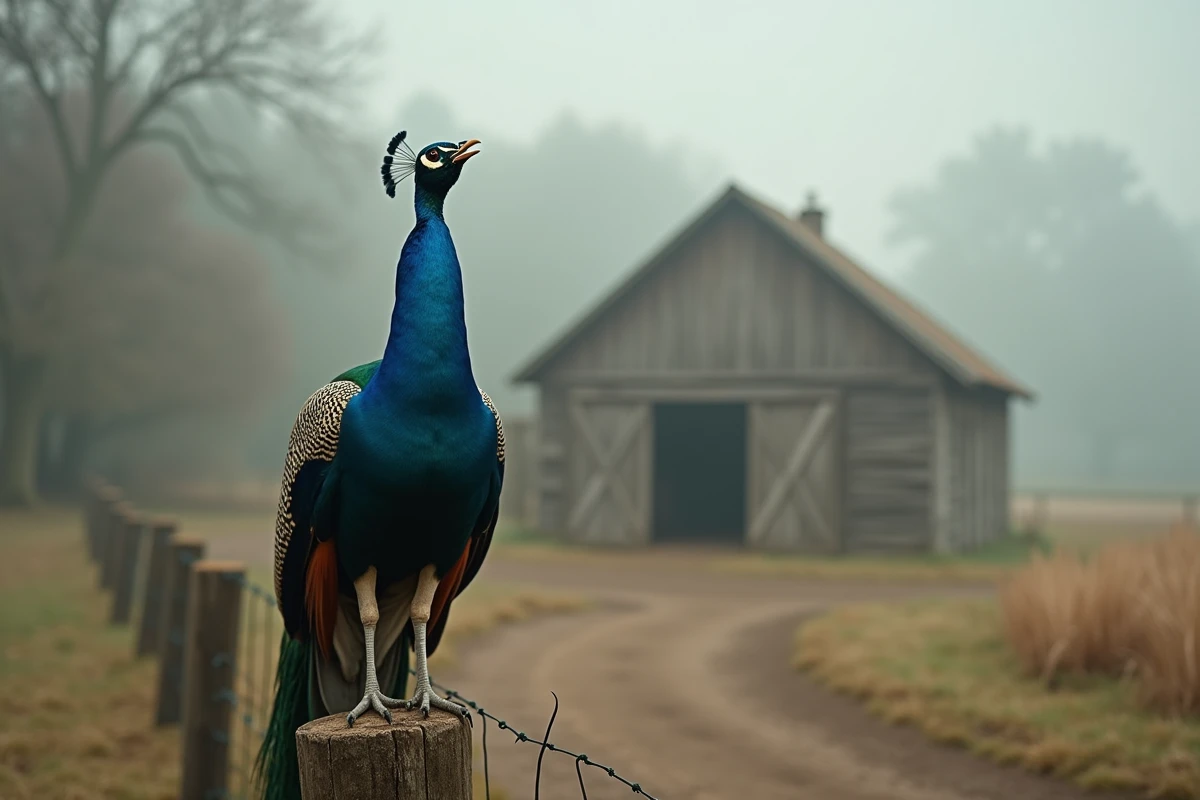
Sound intensity of the peacock’s call: a level comparable to a dog’s bark
The peacock’s noise surprises with its power. Instrumental measurements taken in open fields have shown that the calls of males during the breeding season reach sound levels comparable to those of a large dog’s bark. This intensity, combined with the frequency of calls (sometimes several dozen per hour at the peak of the season), explains why the peacock is perceived as one of the loudest birds in captivity.
The reach of the sound is amplified by the bird’s morphology. The peacock projects its calls from an elevated perch, which increases the distance of propagation. In an open environment, the call carries for several hundred meters without obstruction.
Males vocalize more at night and in the early hours of the day. This behavior, likely linked to less sound competition with other species at these times, poses a practical problem for peacock owners in residential areas.
The role of infrasound in courtship
Research has shown that the fluttering of the peacock’s tail during the display produces low-frequency vibrations, close to infrasound. These vibrations, imperceptible to the human ear, would be detected by females through sensory receptors located on the crest. This complementary communication channel to the audible call adds an extra dimension to the courtship display.
Neighborhood conflicts related to peacock noise in urban areas
The peacock’s call is not limited to naturalist discussions. In several European cities, particularly in the UK, Spain, and France, recent disputes have arisen between residents and peacock owners. Complaints mainly concern nighttime disturbances, with the male being particularly vocal between midnight and dawn during the breeding season.
- Some municipalities have limited the number of individuals allowed per property to reduce the cumulative noise
- Regulations impose a minimum distance between the aviary and neighboring homes
- In some housing developments, keeping peacocks has been outright banned by the homeowners’ association rules
These restrictions reflect a gap between the decorative image of the peacock (associated with parks and ornamental gardens) and the acoustic reality of the animal. One male is enough to disturb an entire neighborhood during the breeding months, which generally extend from spring to early summer.
Before acquiring a peacock, checking local regulations and consulting the neighborhood can avoid costly disputes. Experienced owners also recommend limiting the number of males, as territorial competition among them increases vocalizations.

Peacock call in culture and French expressions
The peacock’s call has influenced the French language beyond zoology. The expression “faire le paon” refers to an ostentatious attitude, directly inspired by the display and calls of the male trying to impress. The verb “paonner”, rarer, describes the act of strutting with affectation.
The word “paon” itself comes from the Latin pavo, and its French pronunciation [pɑ̃] has generated the onomatopoeia “léon” to transcribe the call. This transcription, unique to French, has no direct equivalent in other languages, where the call is often rendered by different syllables.
In symbolism, the peacock oscillates between vanity and immortality depending on the cultures. Its call, deemed discordant compared to the beauty of its plumage, has inspired fables and proverbs about the gap between appearance and reality. Popular tradition sometimes sees it as a warning: visible beauty does not guarantee hidden harmony.
The peacock remains classified in the Phasianidae family, alongside pheasants and guineafowls. Among the three recognized species (blue peacock, green peacock, Congo peacock), only the blue peacock has been domesticated for a long time. The other two species, quieter vocally, are now threatened with extinction.