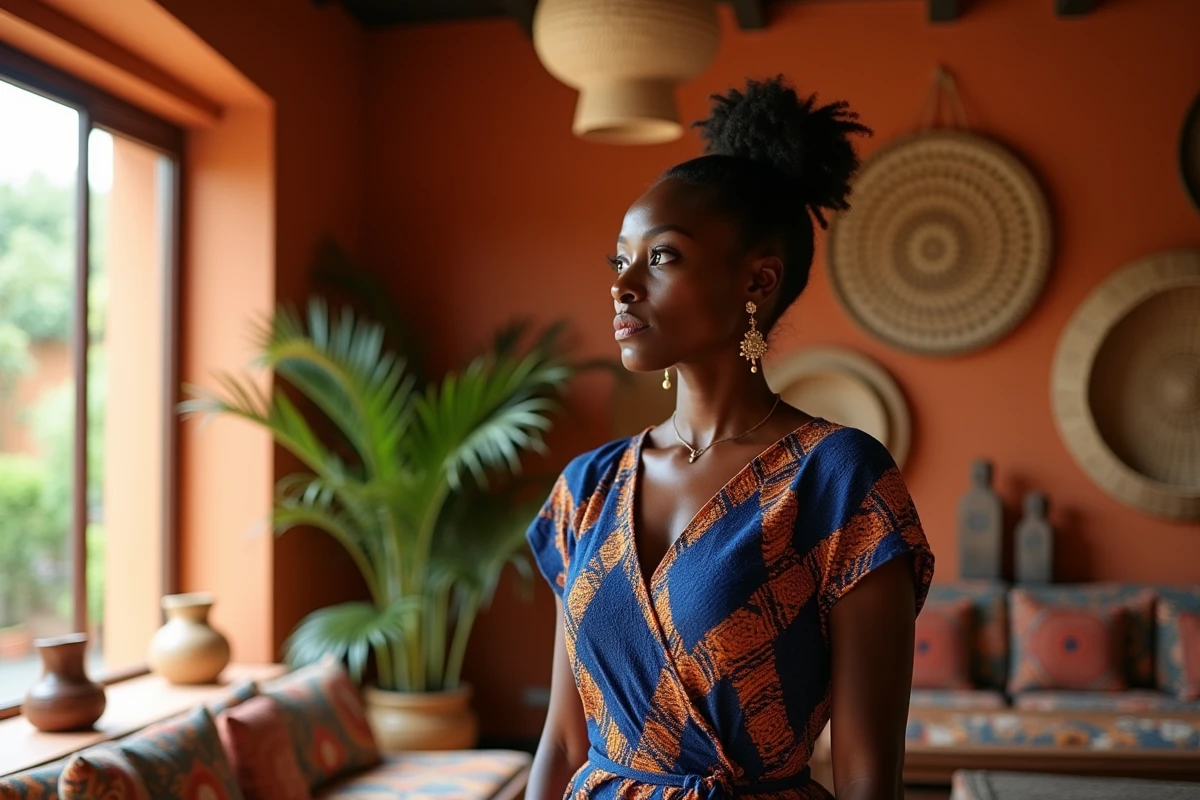
Marie-Aline Meliyi is a journalist at LCI, a familiar figure in the French audiovisual landscape. Her professional journey and personality bear the mark of a dual cultural belonging, between France, where she grew up, and Africa, from which her family originates. This identity construction has shaped her approach to the profession, the topics she presents on screen, and the stance she adopts in the face of discrimination.
Family Transmission and Identity Construction in Paris
Growing up in Paris with parents of African origin creates a specific experience. The child evolves in a French school and social environment while receiving cultural codes, stories, and values from elsewhere at home.
For Marie-Aline Meliyi, this bicultural education laid the foundation for a sensitivity to representation issues. The way others perceive oneself, from childhood, forges a keen awareness of the place society assigns to racialized individuals in public and media spaces.
By exploring Marie-Aline Meliyi’s African origins, we understand that her parents played a structuring role in transmitting a sense of identity pride. This family foundation has nurtured in the journalist a confidence that shines through in her way of speaking on sensitive topics.

Experiencing Racism and Affirmation of Marie-Aline Meliyi’s Personality
In April 2019, Marie-Aline Meliyi publicly denounced the anti-Black attacks she was targeted by. Her reaction, reported by the media NOFI, was summed up in one sentence that encapsulated her state of mind: “We’re still here in 2019.”
This statement was not an isolated act. It was part of a personal trajectory where the refusal of racial injustice dates back to childhood. In an interview with Télé-Loisirs, the journalist confided: “I found it profoundly unfair.” The word “profoundly” indicates that this wound is not superficial but rooted in a repeated experience.
The choice of her colleagues to persuade her to act, which she herself mentioned, also shows that her professional environment recognized the legitimacy of her anger. The support of her peers solidified her decision not to remain silent.
What Racism Reveals in Self-Construction
Experiencing discrimination related to her African origins produces two opposing effects: withdrawal or affirmation. Marie-Aline Meliyi has clearly opted for the latter. Her career at LCI, a 24-hour news channel, exposes her daily to public scrutiny, making her choice all the more significant.
The personality that emerges is that of a woman who transforms the experience of rejection into a professional driving force. The education received from her parents, combined with the challenges faced, has produced a direct and unfiltered relationship with public speaking.
Journalistic Journey and African Cultural Heritage
Marie-Aline Meliyi described her attraction to information as a “conditioning,” according to her own words reported by Télé-Loisirs. This word deserves attention. Conditioning refers to an environment that sustainably shapes interests.
For a child from the African diaspora in France, information is not a neutral flow. Topics related to Africa, migration, and discrimination resonate differently when they touch on family history. Journalism becomes a tool for deciphering one’s own reality.
Several elements of her journey illustrate this connection between origins and professional life:
- The choice of television journalism, where the visibility of a Black woman on air carries an inherent dimension of representation, whether the journalist claims it or not.
- The ability to address societal issues with insights informed by lived experiences of discrimination, not just theoretical knowledge.
- The ease of publicly taking a stand on racism, where other professionals prefer to remain on the sidelines for fear of losing their image of neutrality.
Dual Culture and Women’s Representation in the Media in France
The place of Black women in the French media remains limited. Marie-Aline Meliyi is part of a small group of visible personalities on national news channels. This position is not anecdotal in the construction of her public persona.
Carrying a dual cultural belonging in a still largely homogeneous environment requires developing specific relational skills: navigating between two cultural registers without renouncing either. This ability, acquired from childhood within the family unit, translates professionally into an adaptability that her colleagues have clearly recognized.
Education and Resilience as Markers of Journey
The education transmitted by parents of African origin in France often combines academic rigor with grounding in community values. Without generalizing, this educational framework frequently produces a form of resilience in the face of institutional obstacles.
In Marie-Aline Meliyi’s case, this resilience manifests through a sustainable career in a competitive sector and a free voice on topics that others avoid. Her public persona is the direct product of this dual transmission: professional rigor inherited from the French educational system, determination, and identity pride inherited from her African roots.
Marie-Aline Meliyi’s trajectory illustrates how an identity forged between two cultures is not merely a tug-of-war. It constitutes a foundation from which a unique voice is built, recognizable both on air and in the public space. The fact that she has chosen to openly share her experiences, rather than compartmentalizing them, remains the clearest indicator of the imprint of her origins on her personality.