An outdoor space prepared for summer is not just about placing new furniture on a cleaned terrace. The compatibility between aesthetics, thermal comfort, and maintenance load throughout the season determines the success of a layout. We recommend thinking of each area (garden, terrace, facade) as a system where materials, orientation, and vegetation interact, not as three independent projects.
Albedo of terrace coverings and summer thermal comfort
The choice of flooring for a terrace is often made based on visual criteria. A light reconstituted stone paving or a dark composite behaves very differently under July sun.
Dark shades absorb heat and make the surface scorching hot underfoot by midday. A light covering with low thermal absorption maintains a significantly lower surface temperature, which radically changes the actual use of the terrace between noon and four o’clock.
Solid wood (treated pine, larch, Douglas fir) remains warm underfoot compared to stone or outdoor tiles, but requires annual maintenance (cleaner, saturator). Next-generation composites offer an acceptable thermal compromise, provided you choose co-extruded ranges with capping, which also limit swelling.
Full-body porcelain stoneware terraces, laid on pedestals, provide the best dimensional stability and almost no maintenance. However, their surface can become slippery if the format is too smooth.
Before finalizing a material, it is relevant to prepare your outdoor space with maisonfjord fr on Bobo Le Brico to compare options suited to your configuration.
Shading and natural ventilation in the garden: common mistakes
Installing a shade sail or a cantilever umbrella is not enough to create a cool space. Static shading without ventilation turns the area into a sauna, especially if the ground underneath is mineral and air circulation is blocked by solid screens or overly dense hedges.
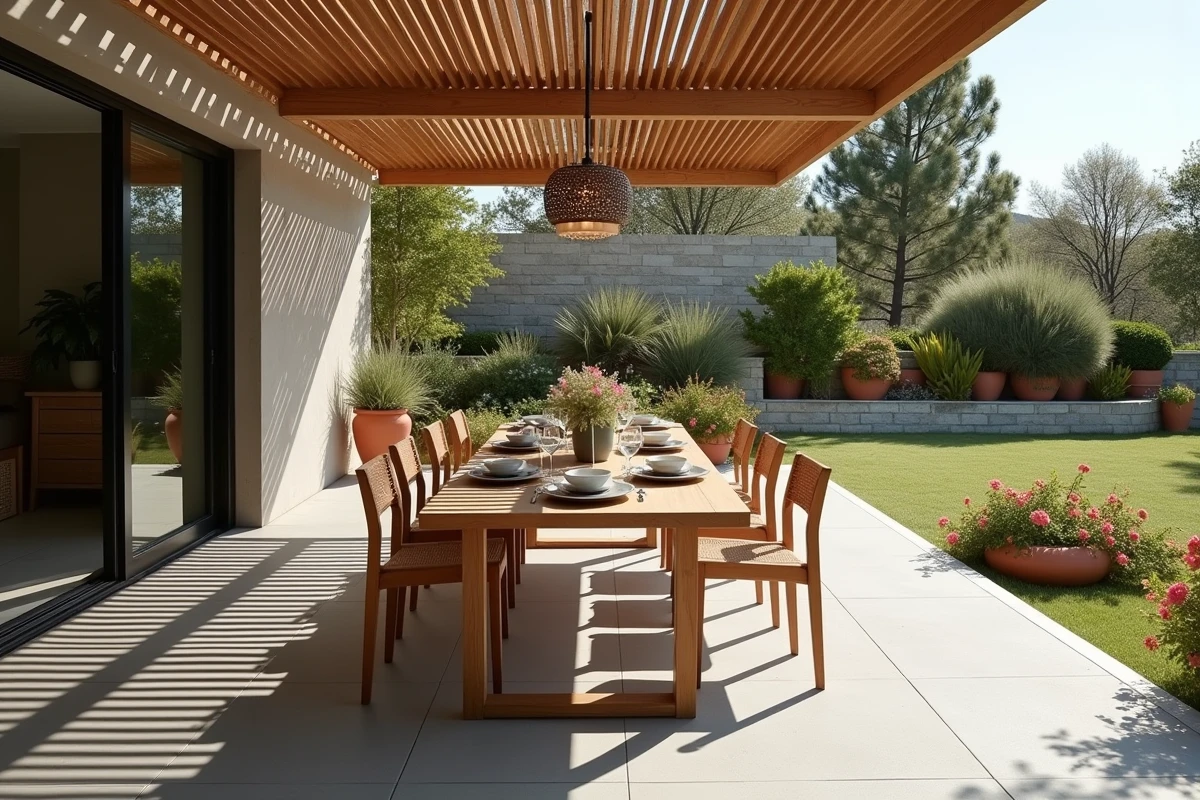
We recommend coupling textile shading (tensioned sail, pergola with adjustable slats) with ground clearance: leaving an air passage between the bottom of the structure and the ground level. Bioclimatic pergolas with adjustable aluminum slats allow you to modulate shading according to the time of day, but their cost and visual footprint may not suit all gardens.
Greening to cool without increasing maintenance
A well-placed deciduous tree (hackberry, plane tree mulberry, field maple) provides natural shade in summer and lets light through in winter. Planting a dense-leaved tree on the south or southwest side of the dining area is the most effective long-term solution.
- Favor species with moderate growth that do not produce messy fruits (avoid fruit mulberry, catalpa with large sticky leaves).
- Install tall grasses (miscanthus, pennisetum) along the terrace edge to filter the wind without blocking air circulation, unlike a rigid screen.
- Use wheeled planters with evergreen shrubs (dwarf pittosporum, compact laurustinus) to modulate privacy as needed without permanent commitment.
A comfortable garden in summer is primarily designed through vegetation and orientation, not by accumulating furniture and decorative accessories.
Facade before summer: coherence of materials and preventive maintenance
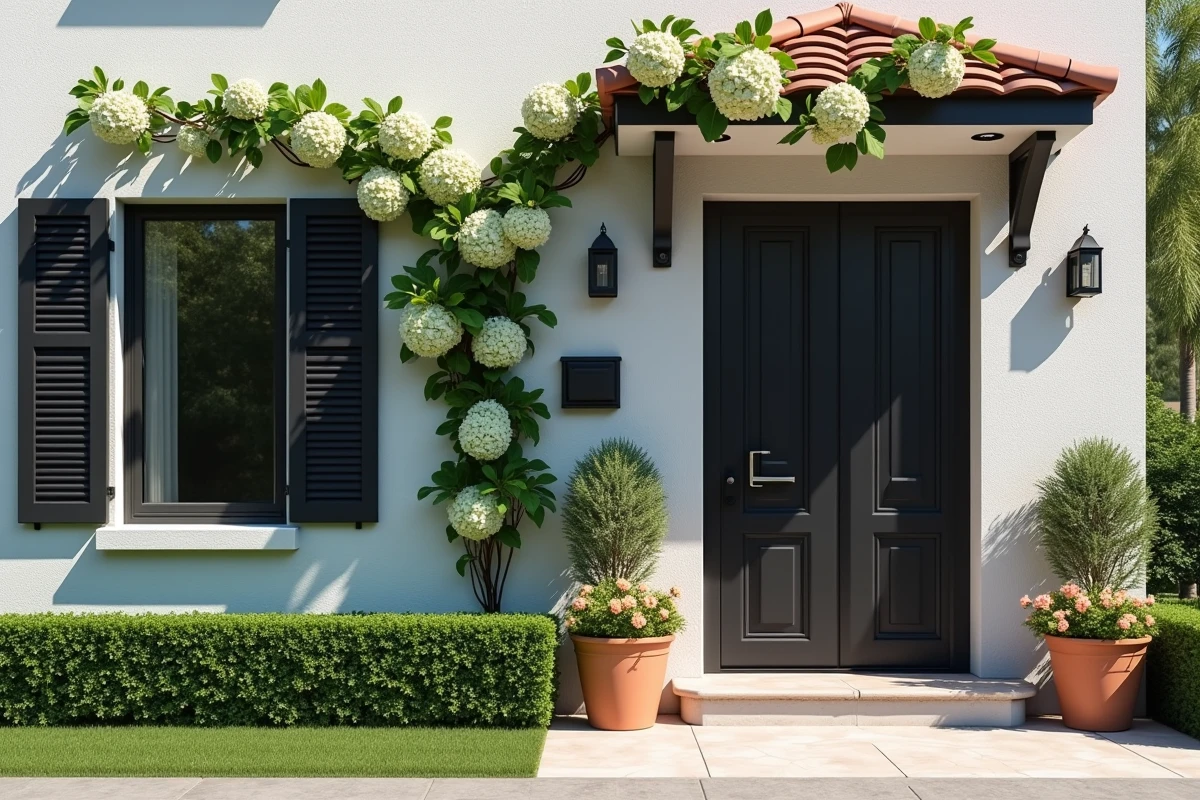
The facade is the visual starting point of any outdoor layout, but its role goes beyond mere aesthetics. A cracked render or untreated gray wood cladding gives an impression of neglect that devalues the entire project, even if the garden behind is impeccable.
Before summer, a low-pressure cleaning (never high pressure on a render, which digs into the joints and peels off the finishes) is enough to restore shine.
Harmonizing fence, pathway, and vegetation in the facade
The visual coherence between the gate, fence, access path, and foreground plantings conditions the overall impression. An anthracite aluminum gate combined with a white PVC fence and raw concrete borders creates a visual patchwork that the most beautiful rosebush cannot compensate for.
We recommend limiting the palette to two or three materials visible from the street. A functional example:
- Fence and gate in the same material or shade (powder-coated aluminum, painted galvanized steel, treated wood).
- Pathway in reinforced stabilized or stone-toned pavers, compatible with the facade’s base.
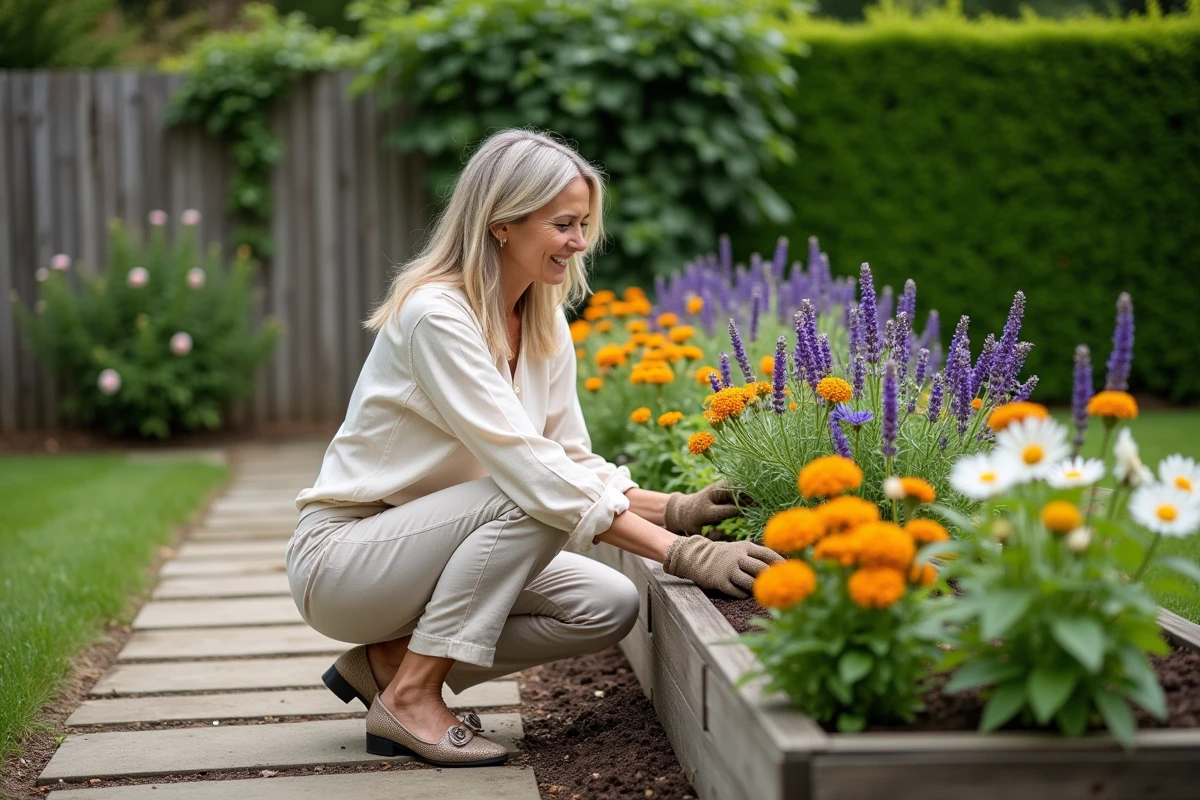
- Low plantings at the base of the facade (lavender, santolina, perennial geranium) that require little watering and do not rise above the window sill.
- In-ground or low bollard pathway lighting, in warm white temperature, which extends the readability of the whole after dark.
Outdoor lighting and furniture: choose for durability, not just decoration
Outdoor lighting is often treated as a decorative accessory. In practice, poorly positioned lighting attracts insects to the dining area and creates annoying shadow zones on pathways.
Placing the main light points around the perimeter of the terrace (embedded in walls, fixed under the pergola) rather than at the center of the table reduces insect nuisance and produces more pleasant indirect lighting. LEDs with a temperature between 2,700 K and 3,000 K provide a warm ambiance without attracting as many mosquitoes as cold-spectrum bulbs.
Outdoor furniture: the trap of “photogenic beauty”
Outdoor furniture made of synthetic rattan or thin steel, ubiquitous in decoration catalogs, ages poorly after the second season if the weaving quality or anti-corrosion treatment is insufficient. Aluminum furniture with removable and washable cushions remains the best durability/comfort ratio for daily use from May to September.
Check the thickness of the aluminum tube, the quality of the stainless steel fittings, and the density of the seat foam before purchase. A comfortable chair in the store but placed on a south-facing terrace without an appropriate cushion becomes unusable in a few weeks.
A successful outdoor layout relies on technical decisions made in advance: orientation, compatible materials, realistic maintenance. These choices, made before the season, determine whether the space will be truly used from May to September.