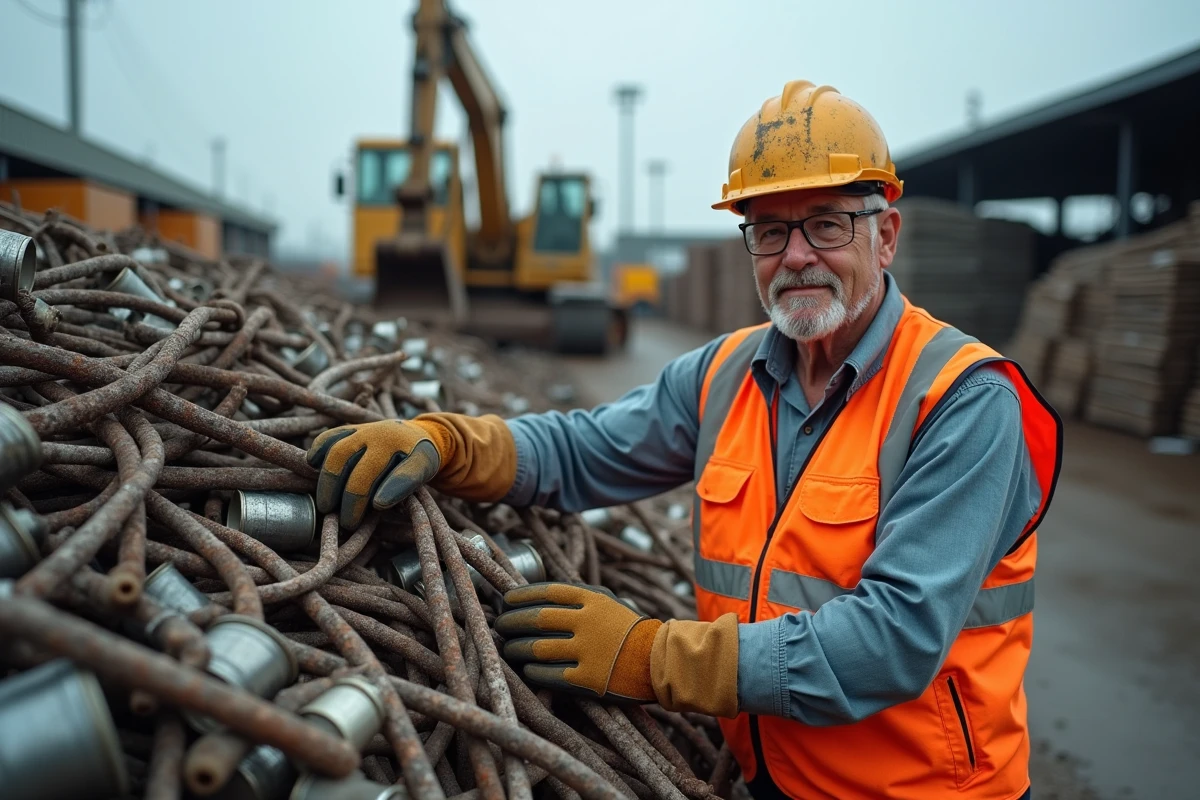
The scrap metal market is not just a fixed price table. The rates offered by Derichebourg, the leading French group in the recycling of ferrous and non-ferrous metals, evolve based on variables that most pricing guides do not address. Understanding these mechanisms allows both individuals and professionals to sell at the right time, rather than suffering from an unfavorable price.
Order books and scrap prices: the link that pricing grids ignore
Derichebourg is a publicly traded company. Its stock price reflects market expectations regarding the demand for steel, the volumes of scrap collected, and transformation margins. The order books, visible on platforms like Boursorama, translate in real-time the buying or selling pressure on the stock.
This detail has a direct consequence for scrap sellers. When the order book shows strong buying pressure on Derichebourg’s stock, it generally signals that analysts anticipate an increase in demand for recycled metals. Buyback sites then adjust their pricing grids upwards, sometimes with a few days’ delay.
For an individual looking to check the current scrap prices at Derichebourg, monitoring the stock’s evolution over a week provides an advanced indicator that static grids do not offer. An upward trend in the stock price over five consecutive sessions often precedes a price reassessment for on-site buyback.

Scrap at Derichebourg: what causes price variations from one site to another
Derichebourg operates a dense network of collection and processing sites in France through its subsidiary Derichebourg Environnement. Buyback rates are not uniform from one depot to another, and several factors explain these discrepancies.
- Proximity to a steel mill or electric furnace: a site located near a final consumer of scrap reduces transportation costs, allowing for a better price to be offered to the seller.
- The type of scrap brought in: heavy scrap (profiles, beams) trades better than light scrap (thin sheets, cans) because it requires less preparation before melting.
- The volume deposited: a contribution of a few kilograms does not justify the same rate as a full bin. Sites apply minimum quantity thresholds for the most advantageous rates.
- The local market conditions: if a site is already saturated with stock, it may temporarily lower its buyback prices to slow down contributions.
Calling the site before going is still the most reliable method. The grids published online, including those of competitors like Bornes Frères or G2D2, are indicative and subject to revision based on LME (London Metal Exchange) prices.
Copper, aluminum, and iron prices: their influence on scrap prices
The price of scrap does not exist in a vacuum. It evolves in an ecosystem where the prices of copper, aluminum, and zinc act as a global barometer. When copper prices rise on international markets, the entire recycled metal sector benefits, including steel scrap.
Several macroeconomic factors weigh on these prices:
- The Chinese demand for steel and non-ferrous metals, which represents a dominant share of global consumption.
- Ecological transition policies in Europe, which stimulate demand for recycled materials at the expense of primary extraction.
- The cost of energy, which directly affects the price of melting in electric furnaces. An increase in energy prices compresses recyclers’ margins and can lead to lower buyback rates.
Inflation also plays an indirect role. During periods of widespread price increases, metals sometimes serve as a safe haven, which supports prices. Conversely, an economic slowdown has the opposite effect, leading to a decrease in industrial demand and thus buyback rates.

Selling scrap to Derichebourg: costly mistakes for individuals
The first mistake is showing up at a site without sorting metals. Mixing copper, brass, aluminum, and scrap in the same batch leads the site to apply the lowest rate of the bunch. Sorting metals before deposit significantly increases the buyback price obtained.
The second mistake is selling on the first day of a price drop out of fear that prices will fall further. Daily fluctuations are normal. Observing the trend over two to three weeks provides a more reliable view than reacting to a single day of decline.
Correctly identifying ferrous and non-ferrous metals
A magnet is enough to distinguish ferrous metals (attracted) from non-ferrous metals (copper, aluminum, zinc, brass). This operation takes a few seconds and changes the pricing category. Bare copper wire, for example, is valued much higher than insulated wire because the recycler does not have to remove the insulation.
A bare copper wire trades at a significantly higher rate than insulated wire. Individuals who take the time to strip their wires before deposit recover a portion of the value that the recycler would otherwise keep to cover processing costs.
Derichebourg and the recycling market in 2024: context and limitations of available data
Derichebourg Environnement remains the main French player in metal recycling, with a network covering the entire territory. The available data do not allow for a universal price per kilo because each site applies its own conditions based on the type of metal and volume.
Field reports vary on the evolution of prices over recent months. Some sellers report stable rates, while others observe frequent adjustments related to LME fluctuations. This disparity confirms that the price of scrap at Derichebourg is not a single figure, but a range that depends on the site, the timing, and the product brought in.
The most profitable reflex remains to combine three sources of information before selling: the trend of Derichebourg’s stock price over the week, the reference metal prices (copper, aluminum, iron) on the LME, and a direct call to the nearest deposit site. Cross-referencing these three indicators provides a much more reliable estimate than a pricing grid published online.