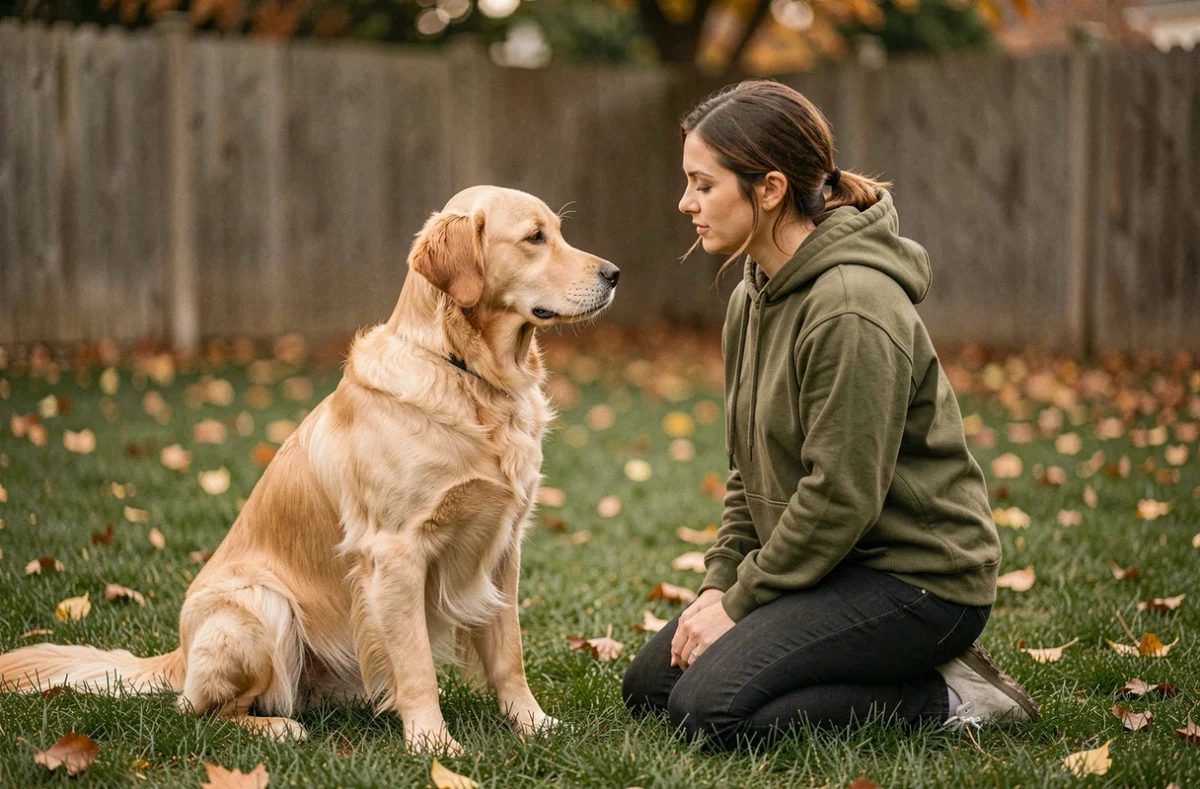
A dog that pulls on the leash, barks at visitors, or destroys objects when its owner is away raises a question that is rarely asked: does this behavior reflect a training issue or an underlying medical problem? The distinction radically changes what to do next.
Dog training depends on being able to read your pet’s signals before trying to correct them. Recent data on relinquishments also show that behavioral difficulties are not the only reason owners give: changes in personal circumstances weigh just as heavily in the decision.
Dog behavior: distinguishing a medical condition from a training issue
A dog that growls when you touch its hip is not defying your authority. It may be in pain. The first step before any training is to rule out a physical cause, and this step is often overlooked.
Certain signs point to a veterinary consultation rather than training. A sudden change in behavior in a previously settled dog points to a health problem, not a whim.
| Observed sign | Possible training issue | Medical cause to investigate |
|---|---|---|
| Refuses to sit on command | Command not properly associated or insufficient motivation | Joint pain (hips, knees) |
| Sudden aggression when touched | Poor socialization | Localized pain, skin infection, ear infection |
| House-soiling in a previously house-trained adult dog | Separation anxiety, disrupted routine | Urinary tract infection, digestive disorder |
| Compulsive licking of one area | Boredom, lack of stimulation | Allergy, dermatitis, foreign object |
| Lethargy, refusal to play | Temporary fatigue | Hypothyroidism, chronic pain |
Timing remains the key distinguishing factor. A behavior that has been present since puppyhood is probably related to learning. A behavior that appears suddenly in an adult dog warrants a veterinary checkup before any training begins.
Specialist resources can help clarify these distinctions: https://www.attitudecanine.fr offers support that takes the dog’s overall profile into account, including its physical condition.

Dog trainer qualifications: what the regulations require
Since January 1, 2025, the requirements for the ACACED (Certificate of Knowledge for Domestic Pets) have changed, particularly regarding the minimum training duration. This certificate remains the regulatory foundation, but the ACACED is not the only proof of professional qualifications.
For certain commercial training or dog-handling activities, regulations also recognize specific diplomas and qualifications. The former certificate of competency remains valid in some cases. It is better to ask a professional directly what qualifications they hold than to assume they followed a standard training path.
What dog owners can check
- Whether the trainer holds a current ACACED or a state-recognized diploma (such as a BP dog trainer qualification)
- The business’s SIRET number, which can be checked in official directories
- The method used during sessions: a qualified professional explains their approach before starting the training
A dog trainer who refuses to specify their qualifications or mentions no certification should raise concerns. Regulations exist to protect animal welfare, not to decorate a website.
Positive reinforcement and judgment bias: what research measures
Positive training is based on a simple principle: reward the desired behavior rather than punish the unwanted behavior. Results observed in practice are well documented. But research goes beyond simply observing obedience.
A recent systematic review examined judgment-bias tests in dogs. These protocols study how an animal responds to an ambiguous situation: an “optimistic” dog approaches an uncertain cue, while a “pessimistic” dog avoids it. The results show a link between positive training methods and optimistic responses, although these tests still have limitations in terms of validity and reliability.
In practical terms, this means that a dog trained with positive reinforcement does more than obey. It approaches new situations with less stress. The difference is not always apparent when asking a dog to “sit,” but it shows in how the animal handles the unexpected.
What positive reinforcement cannot solve on its own
Positive reinforcement has its limits when problematic behavior has a physiological cause. A dog suffering from chronic pain will not respond consistently to a treat-based protocol because the pain outweighs the motivation of food.
Dog training works when the dog is physically and emotionally able to learn. That is why a veterinary checkup should come before a training program in many cases, not the other way around.

Post-adoption support: the first few weeks are crucial
Competitors cover basic commands and puppy socialization extensively. One less-covered topic is helping an adult adopted dog adjust to its new home during the first few weeks. Yet this is when training mistakes can cause the most lasting harm.
A recently adopted adult dog goes through a decompression period that lasts several weeks on average. During this time, its behavior does not reflect its true personality. Trying to correct a behavior during the decompression period risks reinforcing anxiety rather than resolving it.
- During the first three days, the dog is often withdrawn: it eats little, explores little, and sleeps a lot. This apparent calm is not docility
- Between the first and third weeks, its true behaviors begin to emerge: leash pulling, reactivity, vocalizing. This is the time to observe without overreacting
- After about a month, the dog begins to show its basic temperament. Structured training can then begin on a reliable foundation
Data on relinquishments confirm the importance of this issue. There is no comprehensive official annual count of dog relinquishments in France, and estimates vary depending on the methods used. Changes in owners’ circumstances are cited as often as behavioral difficulties. Appropriate support from the time of adoption could help reduce both factors at once.
Dog training is best approached as a process of observation before it becomes a program of correction. A dog whose veterinarian has ruled out any physical cause, whose trainer has verifiable qualifications, and whose owner allows time to adjust after adoption has the basic conditions needed to make lasting progress.